On June 24, the Faculty of International Relations and Political Studies at RANEPA St. Petersburg hosted a working meeting of the research group «Strategic Communications as a Tool for Managing Collective Memory Amidst Geopolitical and Civilizational Confrontation». The event was organized with the support of the Department International Cooperation and moderated by Piotr Smirnov, Associate Professor, Deputy Dean for International Relations.
Goran Latinović, professor at the Faculty of Philosophy, the University of Banja Luka (Republika Srpska, Bosnia and Herzegovina), who had arrived in St. Petersburg to participate in the 10th International Nevsky Forum, joined the meeting as a foreign guest.
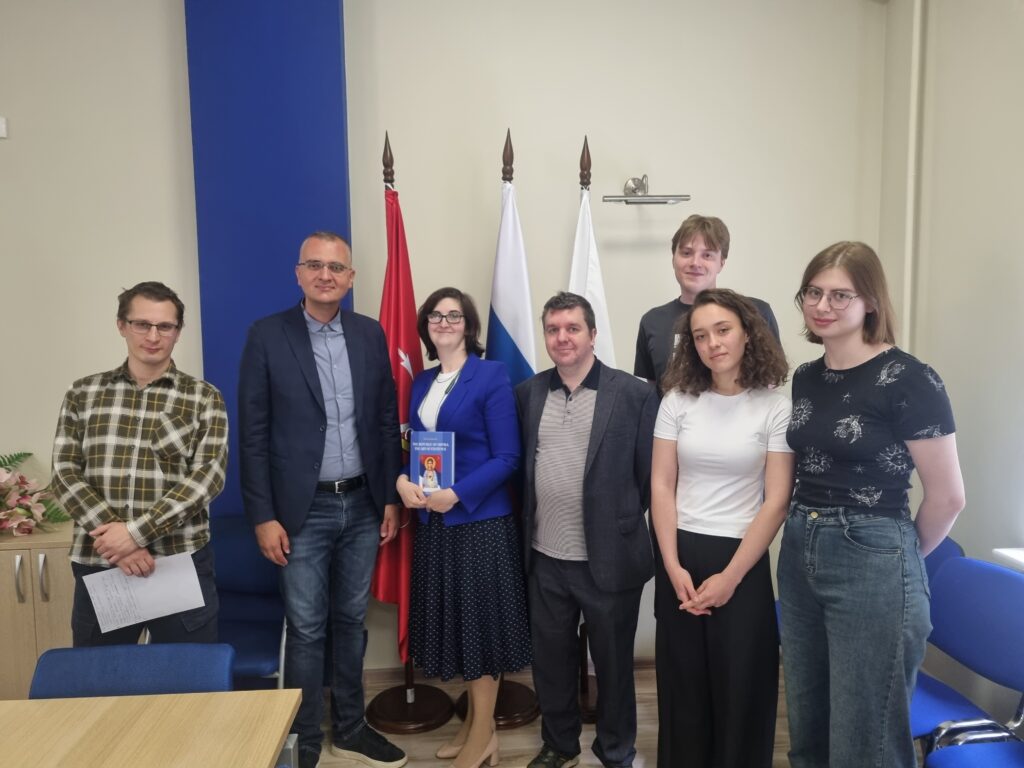
Elizaveta Pronyakina, Associate Professor, RANEPA St. Petersburg; Dmitry Popov, Associate Professor at the Higher School of Media Communications and Public Relations at Peter the Great St. Petersburg Polytechnic University (SPbPU) and RANEPA St. Petersburg third-year students, shared views on the state of historical memory in the Balkan region and a number of post-socialist states. Experts noted persistent trends in the transformation of collective perceptions of the past — trends observable in the countries of the former Yugoslavia, across the former Soviet Union space, and in member states of the Warsaw Pact.
Mr. Latinović highlighted the profound divergence of views among the state’s major ethnic groups regarding the most contentious issues surrounding the interpretation of World War II events and the conflicts in Yugoslavia during the 1990s. This analysis is of great value for the comparative study of the politics of memory across different cultural and civilizational contexts.
Elizaveta Pronyakina, PhD
An important outcome of the working meeting was the agreement to hold a series of joint scientific events aimed at the in-depth study of issues regarding historical memory and gaining a deeper understanding of our countries’ histories.
Goran Latinović presented the faculty with several copies of his monograph on the history of Republika Srpska. The publication will take a worthy place in the academic library and serve as a valuable resource for students and researchers.