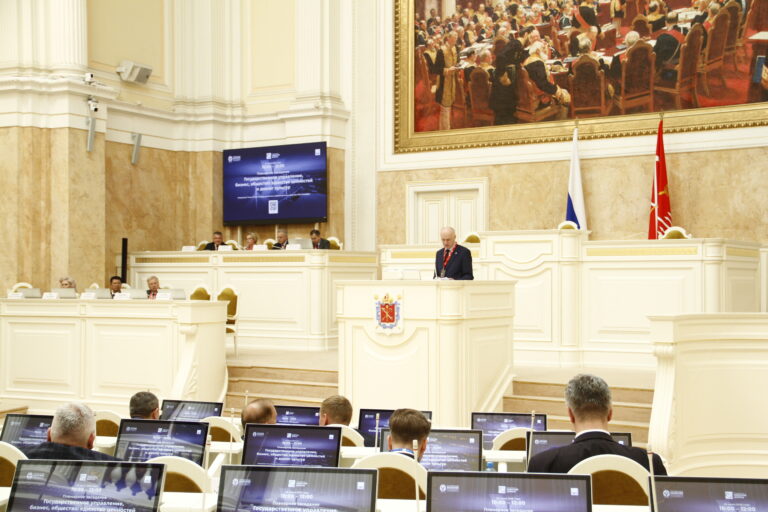
On June 26, the Mariinsky Palace hosted the Plenary Session of the 10th International Nevsky Forum, themed «Public Administration, Business, and Society: Unity of Values and Dialogue of Cultures» organized by RANEPA St. Petersburg.
A large-scale event brought together representatives of federal and regional authorities, leading scholars, experts in education and technology, representatives of the business community and media, and heads of more than ten regional branches of the Presidential Academy.
The audience was welcomed by Alexander Belsky, Chairman of the Legislative Assembly of St. Petersburg; Vladimir Knyaginin, Vice-Governor of St. Petersburg; Maxim Poletaev, Representative of the Russian Foreign Ministry in St. Petersburg, and Evgeny Grigoriev, Chairman of the St. Petersburg Committee for External Relations. Marina Tokareva, RANEPA Vice-Rector, welcomed the participants on behalf of Alexey Komissarov, Rector of the Presidential Academy in Moscow.
Opening the event, Andrey Khlutkov, Director of the Presidential Academy in St. Petersburg, identified a key challenge: developing a shared language of values among the state, business, and society. Amid external pressures, this task has become a strategic priority.
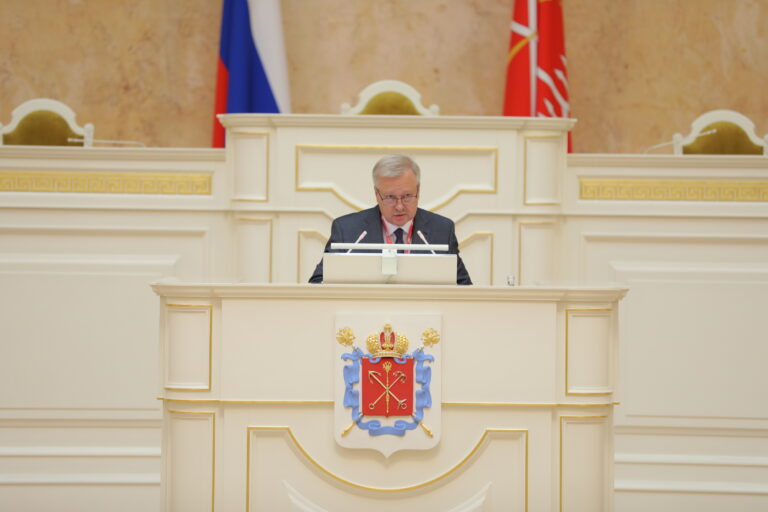
Our most acute conflict today is the clash between formal efficiency and a genuine sense of justice. This issue cannot be resolved through administrative means alone. Work with the younger generation — those who will occupy leadership positions in 10 to 15 years — takes on particular importance. They are the ones who will become statesmen, entrepreneurs, and influencers. The challenge lies in establishing a dialogue with them on equal terms and passing on not only formal knowledge but also a foundation of shared values. I propose viewing young people as key participants in our discussion and as the primary audience for our shared values.
Andrey Khlutkov, Director, RANEPA St. Petersburg
The meeting was attended by approximately 100 participants from 15 countries: Azerbaijan, Armenia, Belarus, India, Kazakhstan, China, Cuba, Kyrgyzstan, Myanmar, Republika Srpska (Bosnia and Herzegovina), Serbia, Slovakia, Tajikistan, Uzbekistan, Uruguay.
Issues regarding education and upbringing led to a broader topic: the dialogue of cultures in public administration. His Excellency Mr. Tin Maung Win, Chairman of Union Civil Service Board of Myanmar, emphasized in his welcoming speech that sustainable development requires close cooperation among the state, the business sector, and civil society, and highlighted the pivotal role of cultural dialogue and shared values in establishing effective governance models. The speaker also addressed the importance of international cooperation in training civil servants capable of meeting the challenges of the digital age.
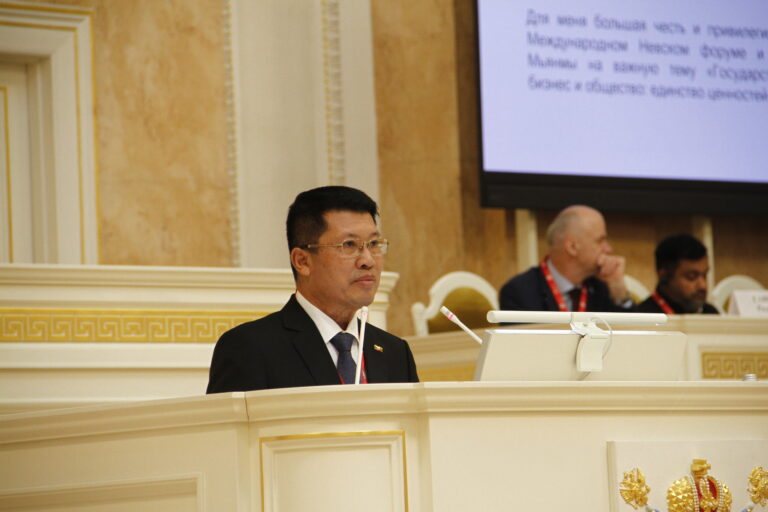
We highly appreciate the experts from the Russian Presidential Academy of National Economy and Public Administration (RANEPA) for conducting the «Digital Transformation in Public Administration» training program this month for twenty trainers from the Civil Service Academies (Upper Myanmar and Lower Myanmar), both in-person and through online learning platforms. This initiative provided an excellent opportunity for professional exchange and for learning from the Russian Federation’s experience in digital public administration. Such cooperation demonstrates the importance of international partnerships in strengthening public sector capacity and preparing civil servants for the challenges of the digital age.
U Tin Maung Win, Chairman of Union Civil Service Board of Myanmar
The question of how joint educational projects can preserve the cultural and value-based identity of the younger generation took center stage in the address by Radoslav Gajanin, Rector of the University of Banja Luka, Republika Srpska (Bosnia and Herzegovina).
Mr. Gajanin spoke about a long-standing cooperation with nearly 40 Russian universities, noting that these academic ties extend beyond institutional frameworks to become a key mechanism for preserving a shared spiritual and historical identity. He highlighted the humanities, social sciences, and medical sciences as priority areas for collaboration and emphasized that student exchanges, summer language schools, and joint creative projects foster personal connections and break down artificially imposed prejudices, laying the foundation for future generations.
When considering the key areas of our cooperation for preserving the shared cultural and value-based orientations of young people, we must highlight several strategic directions. The first and fundamental one is the realm of the humanities—specifically Serbian and Russian studies, as well as our shared history. Language, literature, and historical memory are the bulwarks of our identity. A second important area comprises security studies and the socio-political sciences. We are witnessing aggressive attempts to revise history and undermine traditional values. In this context, lectures by prominent Russian experts play an invaluable role.
The third, vitally important pillar of our cooperation is medical science. Concern for human health and the ideals of the medical vocation are deeply rooted in the values we share. The people sitting in lecture halls today—here in Russia and back home in Republika Srpska—will tomorrow become specialists, leaders, physicians, historians, and professors. It is they who will safeguard, protect, and lead our nations in the future. It is our duty, through academic collaboration, to provide them with a stable, historically grounded, and intellectually solid bridge—one that no one will ever be able to destroy.
Radoslav Gajanin, Rector of the University of Banja Luka, Republika Srpska (Bosnia and Herzegovina)
The Plenary Session served as a vital platform for views sharing and arriving at strategic decisions. Participants agreed that unity in diversity is not merely a topic of discussion but a practical principle that should underpin public administration and the interaction between business and society.